

Sneep Gold Genetic Check
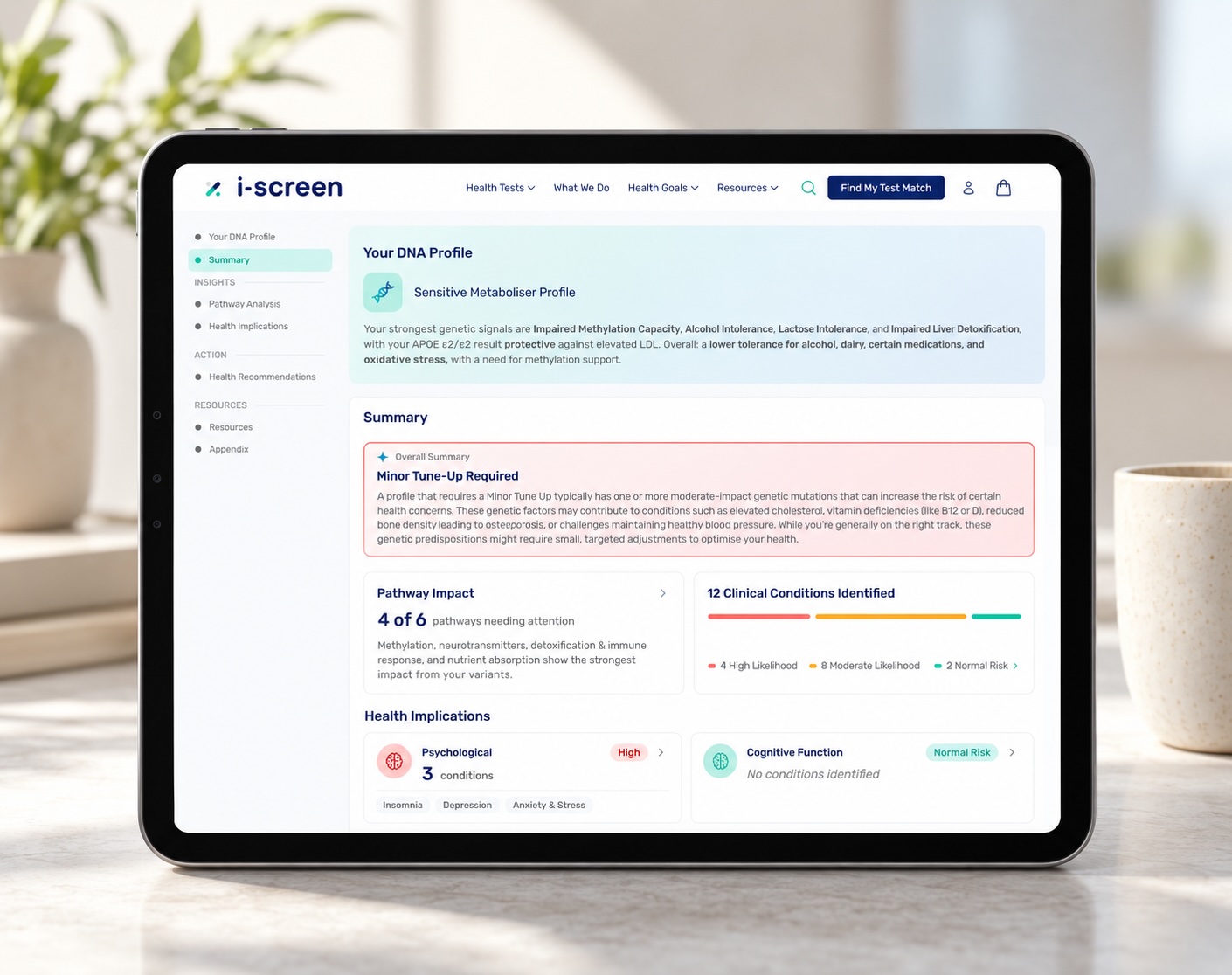
What your results look like
Your results arrive in your i-screen dashboard as a personalised report, not a raw data file.
- Grouped by area of health, not by gene name, so the parts relevant to you come first.
- Each variant explained in plain terms - what the gene does, which version you carry, and how much weight to give it.
- Interpreted here - our molecular biologists and clinicians review your results before the report is issued.
A few results carry more weight than the rest, such as APOE, HFE and the coeliac-associated HLA types. These are flagged clearly, with guidance on when to talk to your GP. Everything else is context for decisions you're already making, and you only need the test once.

What is methylation, and why test it?
Methylation is a chemical process your body runs billions of times a second — attaching methyl groups to molecules in order to switch genes on and off, build neurotransmitters, process hormones, clear toxins and recycle homocysteine.
Variants in the genes running that pathway — MTHFR among them — affect how efficiently it works. That efficiency influences how well you use folate and B12, how you clear oestrogen, and how your body handles the by-products of its own metabolism.
Testing it is a one-time exercise: the variants don't change. What changes is what you do about them — which forms of B vitamins suit you, what your body needs more support with, and what's worth monitoring in your bloods.
This describes how your pathway is built, not a diagnosis. Methylation variants are common, and carrying one is not a condition.
What's included
Your DNA profile summarises the common gene variants you carry and what each tends to influence across nine areas of health, from how you use nutrients to how you respond to training and process common medicines. The variants are grouped below by area of health, and the full list with descriptions is in the sample report. It's a map of tendencies, not a diagnosis.
These variants influence how your body carries cholesterol, whether Lp(a) (an inherited cholesterol particle) tends to run high, and how your blood vessels regulate pressure. Others relate to antioxidant defences in the vessel wall. They show tendencies, not your actual levels. A lipid panel with Lp(a) tells you where you are now.
This section covers how your body regulates blood sugar, uses fat for fuel, and responds to saturated fat. Each variant has a small effect on its own. Together they give you a starting point for how you eat, which your bloods and your own results over time then refine.
These variants show whether you're likely to digest lactose as an adult, why alcohol makes some people flush, how much iron you absorb, and how you use folate, B12, B6, choline and vitamin D. This section also includes the two immune types associated with coeliac disease. Not carrying either makes coeliac very unlikely. Carrying one is common and doesn't mean you have it.
These variants affect how quickly your brain clears dopamine, noradrenaline and serotonin, and how it adapts to stress. They're linked to differences in stress response and focus between people. They don't measure or predict mood or mental health.
One result here carries more weight than the rest. The APOE e4 type is associated with higher cholesterol and an increased risk of Alzheimer's disease in later life. It raises risk rather than determining it, and many carriers never develop the condition. If you carry it, your report explains what it means and suggests talking to your GP. The other variants add context on focus and how the brain adapts.
This section looks at how you process vitamin D for bone and muscle, how your muscles build endurance, and your antioxidant defences during recovery. Training, sleep and protein intake still decide most of the outcome.
These variants influence how strongly your body produces inflammatory signals, and how well your antioxidant and detoxification pathways work. The coeliac-associated immune types appear here too. These are tendencies, not a measure of current inflammation. A high-sensitivity CRP blood test does that.
These variants influence how much testosterone and oestrogen are bound in your blood and how much is freely available, how sex hormones are made and cleared, and how thyroid hormone is activated. Others relate to your circadian rhythm, which interacts with hormone timing. This section also covers how you use folate, which is often discussed with a doctor when planning a pregnancy.
Methylation is how your body passes small chemical tags called methyl groups onto other molecules. It's part of how you recycle homocysteine, make creatine and phosphatidylcholine, and break down dopamine and oestrogen. This profile summarises how the variants you carry are likely to affect that pathway, and which nutrients it relies on most. It's a map of tendencies, not a diagnosis.
MTHFR, MTR, MTRR and CBS all affect how your body clears homocysteine. Some combinations, particularly two copies of MTHFR C677T, are linked to higher homocysteine levels, mostly when folate intake is low. A raised level is associated with cardiovascular risk, but your genes alone don't tell you your level. A homocysteine blood test does.
Homocysteine and the B vitamins that clear it have been studied in relation to brain ageing. Your report shows whether your variants make it harder to keep homocysteine low, which is useful context for how you approach folate, B12 and B6. It doesn't predict memory or cognitive outcomes.
COMT affects how quickly stimulating neurotransmitters are cleared, which some people notice as sensitivity to stress or caffeine late in the day. Your report notes your COMT result in this context. Sleep is shaped far more by routine, light and stress than by any single gene.
Your methylation variants influence which nutrients the pathway leans on most: folate (MTHFR, MTHFD1) B12 (MTR, MTRR) B6 (CBS) choline (PEMT) Your report translates this into practical food and nutrient considerations. These include whether folate-rich foods or particular vitamin forms are worth discussing with your practitioner.
A large share of the body's methylation capacity goes into making creatine and phosphatidylcholine, which support muscle energy and cell membranes. Methylation also helps the liver process compounds such as catechol oestrogens through COMT. Your report shows where your variants may put extra demand on these steps.
Homocysteine is the main link between methylation genes and inflammation. Elevated levels are associated with inflammatory and oxidative stress markers. Your report shows whether your variants make homocysteine harder to clear. Pairing it with a homocysteine blood test tells you where you actually are.
Test instructions

Your cheek swab test kit and all instructions are posted directly to you.

Mail your sample(s) back to the lab using the prepaid envelope and packaging provided.

Results for this test typically available in 2 weeks and will be published in your online dashboard.
Ready. Set. Go!
Buy now for $445

You may also be interested in
Methylation Pathways Test
Follow-up to the Genetic Methylation Test: measures functional metabolic markers for detox, energy and nutrient processing.
Men's Platinum Health Test
Deep insights into cardiovascular, hormonal, nutritional and gut health across 117 biomarkers in one blood test.
Women's Platinum Health Test
Deep insights into cardiovascular, hormonal, nutritional and gut health across 117 biomarkers in one women's blood test.
Comprehensive DNA Test
129 genes, 159 variants — how your DNA shapes nutrition, metabolism, recovery and more. Australian NATA lab.
Genetic Methylation Test
Simple cheek swab testing 129 gene variants linked to detoxification, hormone balance and energy production. NATA accredited.
DNA Nutrition Assessment
Written dietitian assessment of your DNA results with personalised nutrition and supplementation recommendations.