

Men's Platinum Health Test

What does a comprehensive men's health panel cover?
Most general blood tests check a narrow set of markers and tell you whether each sits inside a reference range. A comprehensive panel is built to show how the systems interact — because low energy, poor recovery, stubborn weight or flat mood rarely trace to one number.
This panel pairs a full hormone profile (testosterone, free testosterone, SHBG, oestradiol, FSH, LH, prolactin) with thyroid and adrenal function, insulin resistance markers including HOMA-IR, a full lipid profile with apolipoprotein ratios, iron studies, B12, folate and homocysteine, trace minerals, bone markers, inflammation, and full blood, liver, kidney and pancreatic function. It then adds a gut microbiome screen — beneficial flora, pathogens, yeasts and parasites — because digestion sits underneath much of the rest.
Results describe your current status. They are not a diagnosis, and they're most useful discussed with your GP or practitioner alongside your history.
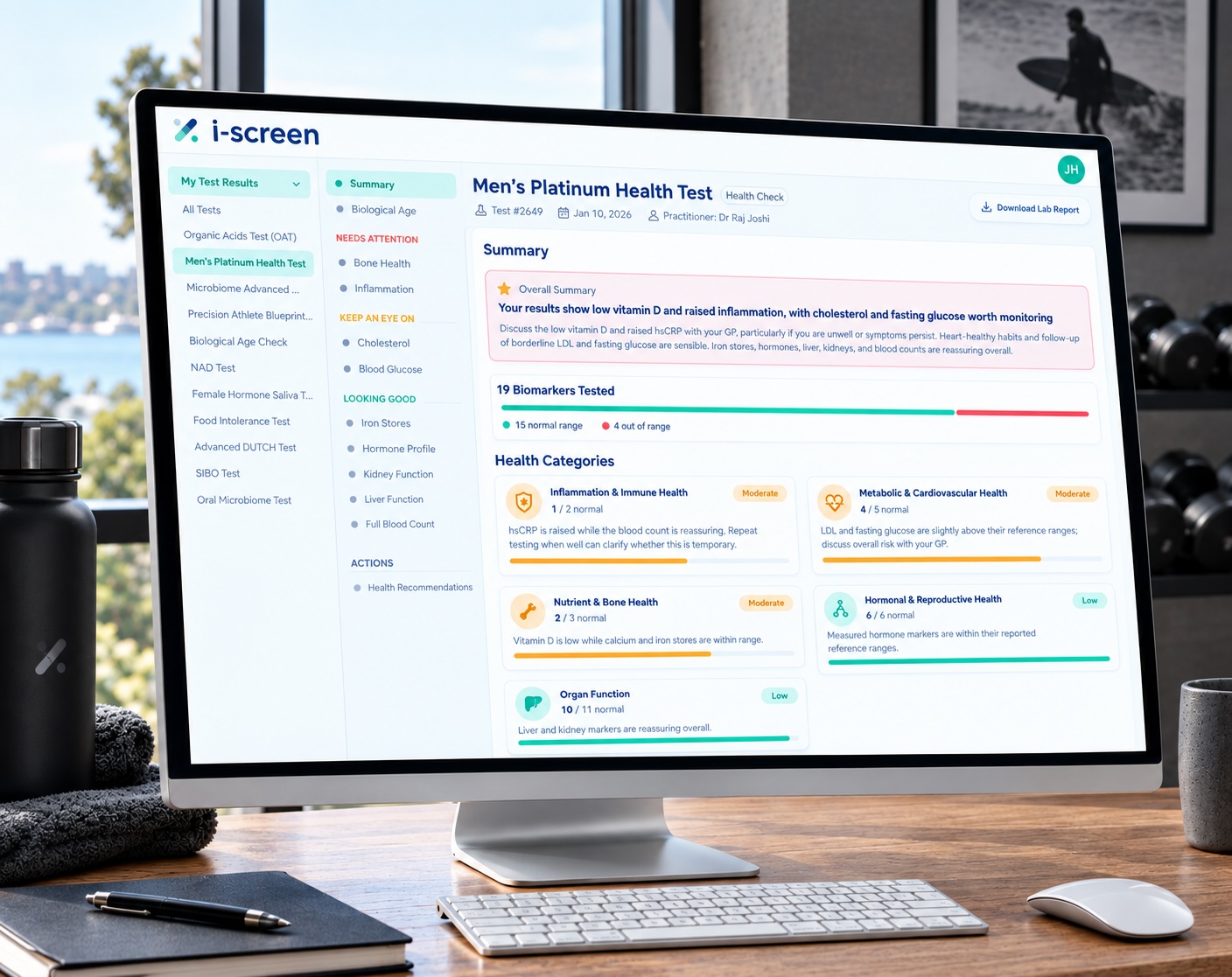
What your results look like
Your results arrive in the i-screen dashboard, organised rather than dumped.
- Six health domains. Every marker is grouped into inflammation and immune health, metabolic and cardiovascular health, nutrient and bone health, hormonal and reproductive health, organ function and detoxification, and biological age — so you read a system at a time, not an alphabetical list.
- Biological age, scored. Nine blood markers are combined into a biological age figure and set against your actual age. It's a single number you can move, and the one most people retest for.
- Every marker in context. Each result shown against its reference range, with the ratios that matter calculated for you — HOMA-IR, Trig/HDL, ApoB/ApoA1, copper-to-zinc — rather than left for you to work out.
- A snapshot summary bringing the key findings, context and suggested next steps together on one screen.
If you want your genetics read alongside the bloods, the Men's Platinum Health & DNA Test adds 129 genes from a cheek swab.
What's included
This snapshot brings together your key results, context, and next steps to give a clear picture of your health.
Our biological age test is a scientifically validated method that uses nine key blood markers to provide personalised insights into your health and ageing. Your biological age score is your biological age compared to your chronological (actual) age.
No matter what your fitness goals are, one of the main determinants of whether you will reach them is your hormonal status. This hormone test measures the key hormones that must be in balance and play an important role in regulating sexual health, fertility and athletic performance.
IGF-1 is involved in a wide range of physiological processes, including bone growth, muscle growth and repair, and the development of the nervous system. It also helps regulate metabolism, including glucose metabolism and fat metabolism.
Cortisol and DHEA-S play important roles in regulating physiological processes in the body. Cortisol has a catabolic effect which mobilises the body’s nutritional resources for fuel. DHEA-S has an opposing anabolic effect and converts food into living tissue. In order to achieve your fitness goals cortisol and DHEA-S must be in proper balance.
Your thyroid gland produces hormones that regulate growth and energy expenditure. Thyroid disorders are quite common, and many people don’t have any symptoms at all. This thyroid test screens for the thyroid hormones that play a key role in regulating the body’s metabolism.
Insulin resistance can lead to difficulty losing weight, distinct abdominal fat, fatigue, bloating and sugar cravings. Identifying insulin resistance early and committing to lifestyle changes can ultimately help the progression to diabetes.
Lipids and cholesterol are fat-like substances in your blood. Some are necessary for good health, but when you have a high level of cholesterol in your blood, a lot of it ends up being deposited in the walls of your arteries and other vital organs. Lifestyle choices including diet, exercise and alcohol intake can all influence cholesterol levels and your risk of developing heart disease.
The apo B/apo A1 ratio indicates the cholesterol balance between potentially atherogenic (bad) and anti-atherogenic (good) particles.
This simple iron test measures how much iron you have in your blood, as well as the amount of iron you have stored in your body. Iron levels are relevant to energy, blood cell health and overall wellbeing.
Vitamin B12 and folate are essential for healthy methylation, a process your body uses for detoxification, energy, and gene regulation. Low B12 can lead to a buildup of homocysteine, which may affect heart, brain, and overall cellular health.
Like vitamins, minerals are substances found in food that your body needs for growth and health. There are two kinds of minerals - macrominerals and trace minerals. Your body needs just small amounts of trace minerals which include iron, copper, zinc and selenium.
Calcium and vitamin D are central to bone health. This panel measures total and corrected calcium, vitamin D, phosphate, magnesium and urate.
Inadequate recovery from exercise or overtraining can be associated with inflammation and muscle damage. In addition to c-reactive protein and creatine kinase, this panel also measures homocysteine which is a recognised risk factor for cardiovascular disease, as well as osteoporosis and Alzheimer’s.
The full blood count measures red cells, white cells and platelets — foundational markers included in most health assessments. It is actually a group of tests that examine different parts of the blood. Results from the following tests provide the broadest picture of your health.
Your liver processes drugs and alcohol, filters toxic chemicals, stores vitamins and minerals, and makes bile, proteins and enzymes. This liver function test measures key liver enzymes and markers relevant to understanding your liver health.
Your kidneys filter waste from your body and regulate salts in your blood. They also produce hormones and vitamins that direct cell activities in many organs and help to control blood pressure. This panel measures key markers of kidney function.
Proteins, fats, and carbohydrates are broken down by stomach acids, enzymes produced by the pancreas, and bile from the liver. This process also releases micronutrients. This blood test measures the levels of enzymes produced by the pancreas.
This snapshot brings together your key results, context, and next steps to give a clear picture of your health.
These markers give a broad picture of how your digestive system is functioning day to day - covering the appearance and consistency of your stool, its acidity, fat content, and whether any blood is present. Together they help flag issues like poor fat absorption, inflammation, or bleeding that may warrant a closer look.
Significant numbers of bacteria are normally present in the healthy gut. Lactobacilli and Bifidobacteria in particular, are essential for gut health because they help to inhibit gut pathogens and carcinogens, control pH, reduce cholesterol and synthesise vitamins.
These bacteria are pathogenic and are those that have the potential to cause disease in the gut.
Our gut bacteria can be divided into ‘bad’ and ‘good’. The good ones for the most part benefit us, whereas the bad 'pathogenic' ones can cause disease. Pathogens are usually present in small quantities in the microbiome, however in excessive amounts they can have adverse effects on the body. The beneficial bacteria of the microbiome have a protective function against colonisation by pathogenic bacteria.
This test looks for evidence of candida or other yeast overgrowth. Whilst yeasts are a normal inhabitant of the gastrointestinal tract, they may become an opportunistic pathogen after disruption of the mucosal barrier, imbalance of the normal intestinal flora or impaired immunity. This can be caused by things like antibiotics, antacids and stress.
Some gut problems can be a consequence of an undetected gut infection. A significant number of IBS (irritable bowel syndrome) cases could actually be due to undiagnosed gut parasites such as Blastocystis hominis and Dientamoeba fragilis.
Test instructions

Download and print your pathology form from your i-screen dashboard.

Fast from all food and drink (other than water) for at least 8 hours, and no more than 12 hours prior to your test.

Visit the collection centre within one hour of waking for the most accurate hormone test measurements.

Your stool test kit and all instructions are posted directly to you.
Ready. Set. Go!
Buy now for $759

Common Questions
You may also be interested in
Complete Microbiome Mapping (PCR) - GI Map
Advanced DNA-based PCR gut test measuring bacteria, pathogens, parasites, viruses and inflammation markers.
Comprehensive DNA Test
Screen 129 genes across digestion, hormones, athletic performance and longevity with a simple cheek swab. Australian NATA lab.
Genetic Methylation Test
Simple cheek swab testing 129 gene variants linked to detoxification, hormone balance and energy production. NATA accredited.