
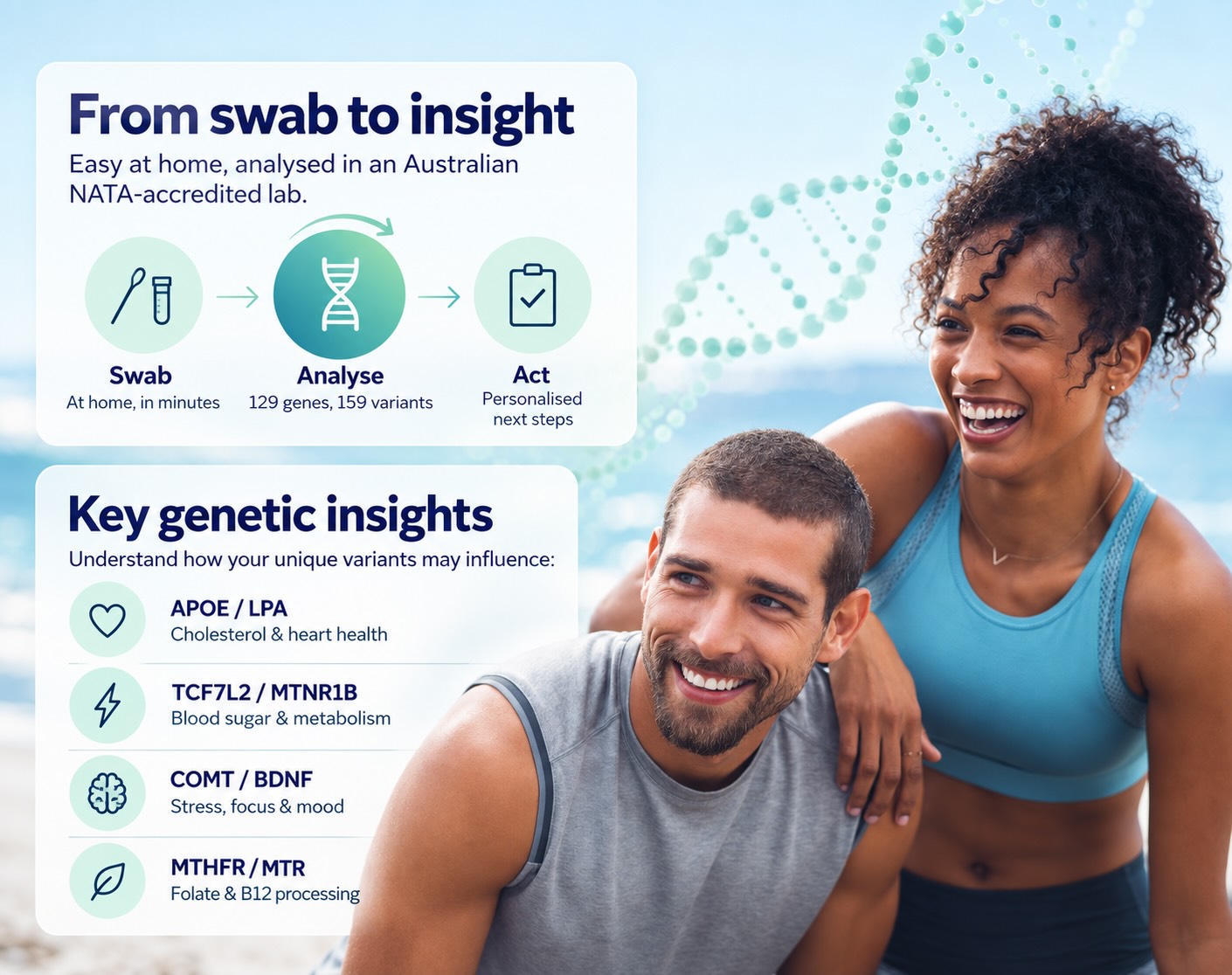
Comprehensive DNA Test
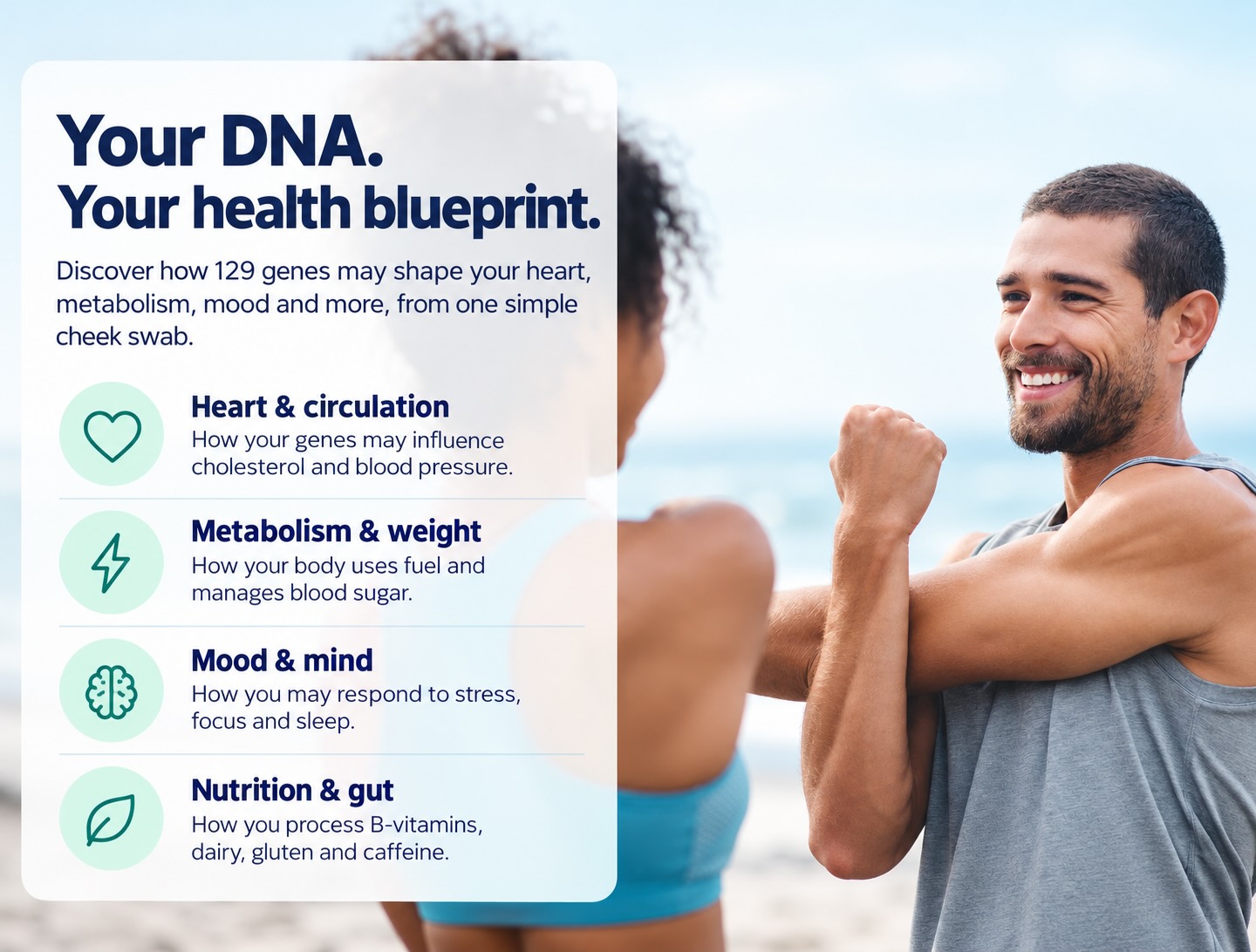
What is a comprehensive DNA test?
Some things about your health don't shift no matter what you do. Caffeine keeps you up when it doesn't bother anyone else. Dairy has never agreed with you. Some of that is habit, and some of it is written into your genes.
This test reads common gene variants and explains what each tends to influence: how you use nutrients, handle fats and sugars, respond to training, and manage inflammation. Each variant has a small effect. Your sleep, food, training and stress still decide most of the outcome.
Worth considering if you:
-
- Want to know why some food or training approaches work for you and others don't
-
- React unusually to caffeine, alcohol or certain foods
-
- Are building a nutrition or training plan and want a personal starting point
What your results look like
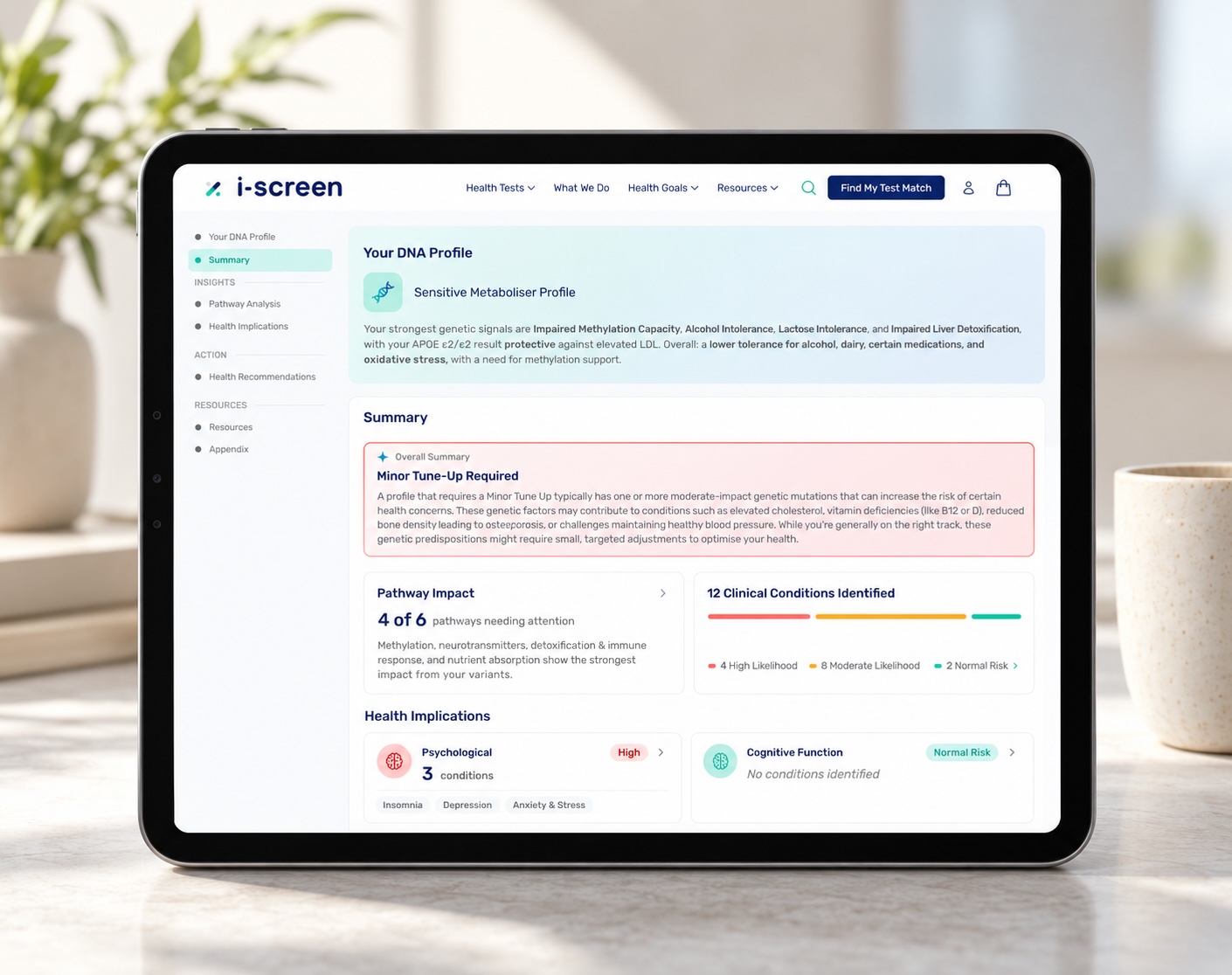
Your results arrive in your i-screen dashboard as a personalised report, not a raw data file.
- Grouped by area of health, not by gene name, so the parts relevant to you come first.
- Each variant explained in plain terms - what the gene does, which version you carry, and how much weight to give it.
- Interpreted here - our molecular biologists and clinicians review your results before the report is issued.
A few results carry more weight than the rest, such as APOE, HFE and the coeliac-associated HLA types. These are flagged clearly, with guidance on when to talk to your GP. Everything else is context for decisions you're already making, and you only need the test once.
What's included
Your DNA profile summarises the common gene variants you carry and what each tends to influence across nine areas of health, from how you use nutrients to how you respond to training and process common medicines. The variants are grouped below by area of health, and the full list with descriptions is in the sample report. It's a map of tendencies, not a diagnosis.
These variants influence how your body carries cholesterol, whether Lp(a) (an inherited cholesterol particle) tends to run high, and how your blood vessels regulate pressure. Others relate to antioxidant defences in the vessel wall. They show tendencies, not your actual levels. A lipid panel with Lp(a) tells you where you are now.
This section covers how your body regulates blood sugar, uses fat for fuel, and responds to saturated fat. Each variant has a small effect on its own. Together they give you a starting point for how you eat, which your bloods and your own results over time then refine.
These variants show whether you're likely to digest lactose as an adult, why alcohol makes some people flush, how much iron you absorb, and how you use folate, B12, B6, choline and vitamin D. This section also includes the two immune types associated with coeliac disease. Not carrying either makes coeliac very unlikely. Carrying one is common and doesn't mean you have it.
These variants affect how quickly your brain clears dopamine, noradrenaline and serotonin, and how it adapts to stress. They're linked to differences in stress response and focus between people. They don't measure or predict mood or mental health.
One result here carries more weight than the rest. The APOE e4 type is associated with higher cholesterol and an increased risk of Alzheimer's disease in later life. It raises risk rather than determining it, and many carriers never develop the condition. If you carry it, your report explains what it means and suggests talking to your GP. The other variants add context on focus and how the brain adapts.
This section looks at how you process vitamin D for bone and muscle, how your muscles build endurance, and your antioxidant defences during recovery. Training, sleep and protein intake still decide most of the outcome.
These variants influence how strongly your body produces inflammatory signals, and how well your antioxidant and detoxification pathways work. The coeliac-associated immune types appear here too. These are tendencies, not a measure of current inflammation. A high-sensitivity CRP blood test does that.
These variants influence how much testosterone and oestrogen are bound in your blood and how much is freely available, how sex hormones are made and cleared, and how thyroid hormone is activated. Others relate to your circadian rhythm, which interacts with hormone timing. This section also covers how you use folate, which is often discussed with a doctor when planning a pregnancy.
Some genes affect how quickly your body processes common medicines. That can change how well a drug works, or how likely you are to get side effects. This section covers blood thinners, some pain relievers, reflux medicines, some antidepressants and a cholesterol medicine. It's not a complete medication profile. Don't start, stop or change any medication based on these results. Take your report to your doctor or pharmacist.
Test instructions

Your cheek swab test kit and all instructions are posted directly to you.

Mail your sample(s) back to the lab using the prepaid envelope and packaging provided.

Results for this test typically available in 2 weeks and will be published in your online dashboard.
Ready. Set. Go!
Buy now for $389

Common Questions
You may also be interested in
Men's Platinum Health Test
Deep insights into cardiovascular, hormonal, nutritional and gut health across 117 biomarkers in one blood test.
Women's Platinum Health Test
Deep insights into cardiovascular, hormonal, nutritional and gut health across 117 biomarkers in one women's blood test.
DNA Nutrition Assessment
Written dietitian assessment of your DNA results with personalised nutrition and supplementation recommendations.