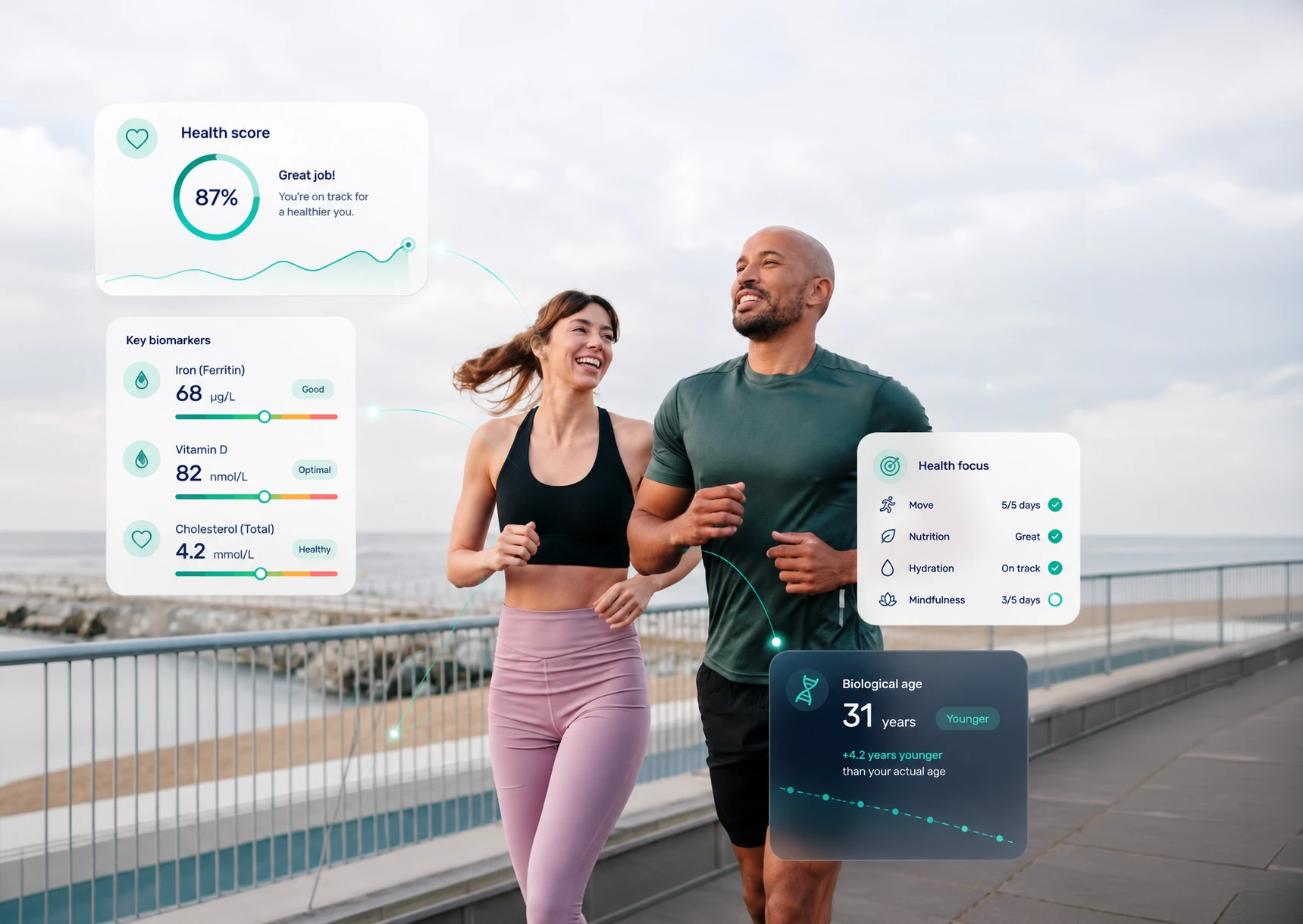
Training harder than usual and feeling worse for it is a common and confusing experience in endurance and high-volume sport. Performance flattens, recovery drags, and a routine blood test often comes back looking unremarkable. For some athletes, the marker worth checking isn't on that standard test: ferritin, the main measure of the body's stored iron.
This guide covers why athletes are more likely to run low on iron, why ferritin is the marker to check, and how testing works in Australia.
Why athletes are more likely to run low on iron
Several things combine to push an athlete's iron needs above those of a less active adult. After strenuous exercise, the body releases more of a hormone called hepcidin, which temporarily reduces how much iron the gut absorbs. In menstruating athletes, monthly blood loss is a major contributor. Iron is also lost in sweat, urine and the gut, and repeated foot strike in running can break down a small number of red blood cells (foot-strike haemolysis).1How much each factor matters varies from person to person, and they have not been ranked by size.
Distance runners, vegetarian athletes and regular blood donors are considered at highest risk.1Female athletes are also more affected: international studies estimate iron deficiency in roughly 15–35% of female athletes compared with 5–11% of male athletes,2 and female athletes' iron requirements may be up to 70% higher than the standard estimate.1 Adolescents may be at higher risk, particularly during periods of rapid growth, and so are athletes who are not eating enough to match their training load, since lower food intake usually means lower iron intake.1 Any athlete training at volume can run low, though.
Why ferritin is the marker to check
Iron deficiency usually develops in stages. Iron stores fall first, then the body's working iron supply runs short, and only later does haemoglobin, the iron-carrying protein in red blood cells, drop far enough to cause anaemia.2Ferritin reflects the first of these stages, and in the absence of inflammation it is considered the best early indicator of iron status.1 That means a full blood count can look normal while ferritin is already low.
Ferritin has one important limitation. It rises as part of the body's response to inflammation and infection, so a normal-looking result does not always rule out low stores.1,3It can also be raised for a period after very heavy or prolonged exercise. There is no reliable formula for adjusting ferritin when inflammation is present, so clinical judgement is still needed.3 This is why ferritin is best read alongside haemoglobin, transferrin saturation and an inflammatory marker, rather than on its own.2,3 Having the test when well, and not straight after an unusually hard session or race, also helps.
What low iron can look like in training
Low iron status is linked to symptoms that overlap heavily with normal training fatigue, which is part of why it is easy to miss: • Persistent fatigue that doesn't improve with rest • A performance plateau or decline despite consistent training • Slower recovery between sessions • Reduced endurance capacity
How strongly these symptoms are tied to iron depends on how far the deficiency has gone. Iron deficiency can impair muscle function and work capacity, and once it reaches anaemia the effect on endurance is well established and warrants medical treatment.1When ferritin is low but haemoglobin is still normal, the evidence is more mixed. In a randomised trial of recreationally active women with low iron but no anaemia, intravenous iron improved fatigue scores and running economy but not peak aerobic capacity.4 A review of intravenous iron in adults without anaemia found improvements in fatigue and oxygen uptake, with considerable variation between studies,5 while an earlier systematic review found iron did not consistently improve performance measures.6 None of these symptoms confirm low iron on their own, as they have many other possible causes. When several appear together during heavy training, iron studies are a reasonable test to consider.
How much ferritin is enough for an athlete?
There is no single agreed answer. The leading sports nutrition position statement notes there is no agreement on the ferritin level that signals problematic iron depletion in athletes, with suggested cut-offs ranging from below 10 to below 35 ng/mL (equivalent to µg/L).1General population thresholds, often somewhere between 15 and 30 µg/L, vary by laboratory and population,3 and the cut-offs used in athlete research vary widely between studies.2 In short, athlete-specific thresholds are based largely on expert practice, differ between organisations, and are still being studied.
In practice, a ferritin result near the bottom of the normal range may mean something different for a high-volume athlete with symptoms than for a less active adult. That is a judgement best made by a GP, sports physician or sports dietitian who knows the athlete's training and diet, rather than by reading the result against a general range alone.
How to test iron and ferritin in Australia
Testing does not require a GP referral. The Iron Studies Test measures iron, ferritin and transferrin together, giving a fuller picture than a ferritin result alone. For athletes who want a broader nutritional check, the Nutrition Micronutrient Test screens iron alongside 26 other vitamins and minerals in one order.
Order online, collect a sample at a partner collection centre, and view results through the online dashboard once a NATA-accredited lab has processed them.
Making sense of the results
Iron and ferritin results are best interpreted alongside training load, diet, symptoms, menstrual history and any other relevant markers, and by a GP or practitioner who can take athlete-specific considerations into account. Routine iron supplementation without confirmed low iron is not recommended: it does not improve performance in athletes whose iron is adequate, and it can cause side effects such as gut upset.1Where results are low, a sports dietitian can help review iron intake and absorption from food before or alongside any supplementation. Our Athletic Performance & Recovery hub covers the broader range of training-relevant markers if fatigue or recovery concerns extend beyond iron. If fatigue is the main concern and training load isn't the obvious explanation, our Energy, Stress & Sleep hub and Nutrition, Micronutrients & Cellular Health hub are also worth a look.
This article is for general information and does not replace advice from a qualified health practitioner. Always discuss test results with a GP, sports physician or other treating practitioner, and do not begin iron supplementation without professional guidance.